
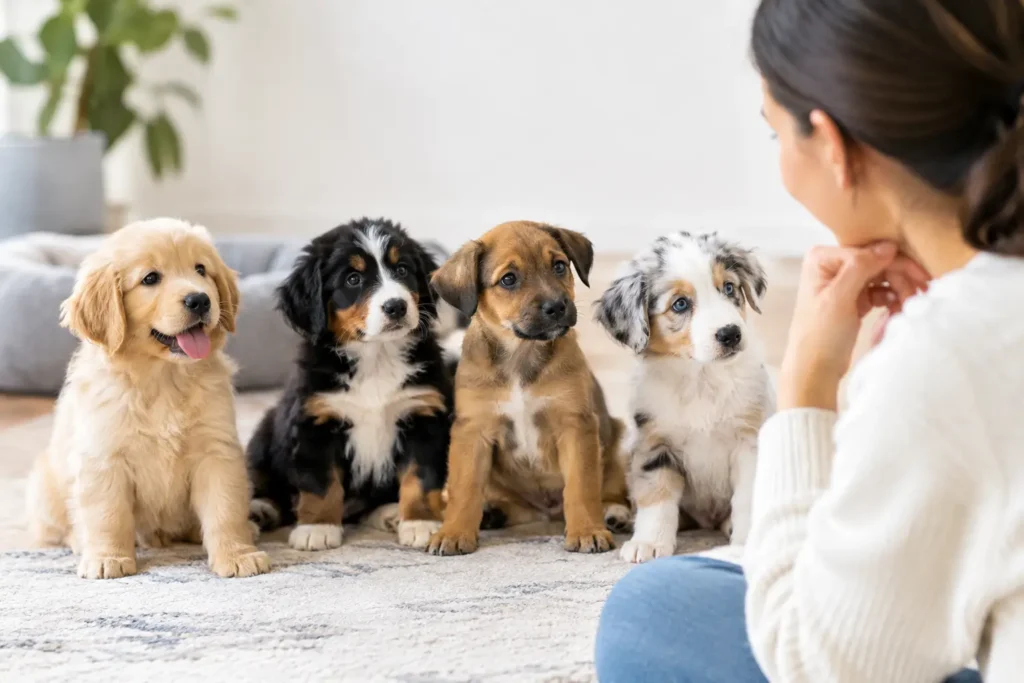
A puppy may look calm because it has just woken up, or extra bold because its littermates are nearby. That is why learning how to compare puppy temperaments means looking beyond the cutest face or the puppy that runs to you first. The right match is not always the quietest, smallest, or most playful puppy. It is the puppy whose natural energy and social style fit your home, routine, and experience.
For families choosing a puppy in Malaysia, temperament deserves the same careful attention as vaccination records, health checks, breed size, and grooming needs. A healthy puppy needs a home where it can feel safe, understood, and properly guided.
What Puppy Temperament Really Means
Temperament is a puppy’s natural tendency to respond to people, handling, new sounds, play, rest, and unfamiliar situations. It is not a fixed prediction of everything your dog will become. Training, early socialization, daily routine, and the way a family responds to the puppy all make a difference.
Still, puppies do show early patterns. One may eagerly approach visitors and recover quickly after a surprise sound. Another may watch quietly from a distance before joining in. A third may be constantly ready to play, mouth hands, and chase moving toys. None of these traits automatically makes a puppy good or bad. They simply point to different needs.
A confident, active puppy can be wonderful for an experienced owner who enjoys training and regular play. A gentler puppy may suit a couple seeking a quieter companion. For a busy family with young children, a puppy that is friendly but able to settle may be easier to manage than one that becomes overstimulated quickly.
How to Compare Puppy Temperaments in Person
The best comparison happens when you meet puppies calmly and give each one a little time. Avoid making a decision in the first minute. A puppy may need to sniff, observe, or wake up before showing its usual behavior.
If you are choosing between puppies from the same breed or litter, try to observe them under similar conditions. Meet them at roughly the same time of day and in the same area when possible. A puppy that has just finished an exciting play session may seem calmer than a puppy that has been resting.
Watch the first approach
Sit or stand quietly and let the puppies come to you. Notice whether each puppy approaches with relaxed curiosity, rushes in without pause, hangs back to observe, or avoids interaction altogether. A puppy does not need to jump into your lap to be loving. A puppy that approaches slowly, sniffs your shoe, and then returns for attention may simply be thoughtful and gentle.
Look for loose, comfortable body language. A softly wagging tail, relaxed ears, a curious sniff, and willingness to engage are generally encouraging signs. Constant freezing, repeated hiding, or panic when people move nearby may mean the puppy needs more support and patient socialization. It can also mean the puppy is tired or in an unfamiliar mood, so ask to observe again rather than drawing a quick conclusion.
Compare play styles, not just energy levels
Play reveals a great deal. Some puppies love chasing a toy, some prefer wrestling with littermates, and some are more interested in people than objects. An energetic puppy is not necessarily difficult, but it will likely need more daily engagement, training games, and appropriate exercise as it grows.
Notice whether the puppy can pause after excitement. A puppy that plays enthusiastically and then settles beside you has a different rhythm from one that stays highly aroused, bites harder when excited, or struggles to switch off. Families often underestimate how valuable an off-switch can be, especially in apartments, condominiums, or homes with children.
Gently check comfort with handling
Every puppy will need to be handled for grooming, nail trims, veterinary visits, bathing, and daily care. With guidance from the staff, gently stroke the puppy’s back, touch its paws briefly, and lift it only if it is safe and comfortable to do so.
A puppy may squirm a little, which is normal. The more useful question is whether it relaxes when handled with kindness or becomes increasingly distressed. Small companion breeds with regular grooming needs, such as Poodles, Maltese, Shih Tzus, and Maltipoos, especially benefit from early comfort with brushing and gentle handling.
Notice recovery after a mild surprise
A normal new sound, such as a toy dropping nearby or a door closing, can show how a puppy processes change. Do not deliberately frighten a puppy or perform harsh “tests.” Instead, observe natural moments.
A steady puppy may look toward the sound, pause, and return to exploring. A more sensitive puppy may step back and need reassurance before continuing. Sensitive puppies can become deeply devoted companions, but they usually do best with calm handling and a patient household. Quick recovery often matters more than never being startled at all.
Ask Questions That Give You the Full Picture
A short visit cannot tell you everything. A responsible puppy seller should be able to explain the puppy’s routine, health care, and personality as they have observed it over time.
Ask how the puppy behaves around people, siblings, toys, food, and everyday activity. Find out whether it is usually playful, cuddly, independent, vocal, or more reserved. Ask what kind of exposure it has had to gentle handling, grooming, household sounds, and different people.
It also helps to ask about the parents’ general temperament when that information is available. Friendly, stable parents can be a positive sign, although each puppy is still an individual. Most importantly, request clear vaccination and veterinary health records. Health and temperament are connected in practical ways: a puppy that feels unwell, uncomfortable, or overtired may not behave as it normally would.
Match the Puppy to Your Real Home Life
Choosing based on your ideal lifestyle can lead to disappointment. Choose based on the life you actually have on weekdays.
If your family has young children, look for a puppy that is social, resilient, and comfortable with gentle handling. Children must also learn to give the puppy space while eating, sleeping, or resting. Even the most patient puppy needs a quiet place of its own.
For first-time owners, a puppy that is people-oriented and responsive can make early training feel more manageable. That does not mean you should avoid every spirited puppy. It means you should be honest about the time available for toilet training, socialization, grooming, play, and basic obedience.
Breed traits offer useful context, but they should not replace meeting the individual puppy. A Beagle may be more scent-driven and lively than a Maltese, while a Golden Retriever may be highly social and active. Yet within every breed, one puppy may be calmer, bolder, more independent, or more affectionate than another.
Your living space matters too. A high-energy puppy can live happily in a smaller home if the family provides training, enrichment, and appropriate daily activity. A calm puppy can also become restless without attention. There is no “low-maintenance” puppy, only a better or less suitable match for your household.
Avoid These Common Comparison Mistakes
Do not choose only the puppy that appears saddest or quietest in the corner. It may simply be sleepy, adjusting to visitors, or naturally reserved. Likewise, do not assume the puppy that pushes to the front is automatically the friendliest. Confidence can be appealing, but a very intense puppy may need more consistent boundaries and training.
Avoid judging a puppy after one short interaction. If you feel uncertain, ask for more time to observe, ask questions, and compare notes with everyone in your household. It is better to take a thoughtful approach than to make an emotional decision and realize later that your routine is not a good fit.
Also, never expect temperament alone to solve training challenges. A sweet puppy still needs structure. Early toilet training, reward-based guidance, safe socialization, quality food, comfortable bedding, toys, and regular veterinary care all help a puppy grow into a secure adult dog.
Choose With Care and Confidence
The puppy that fits your family may not be the one everyone notices first. It may be the cheerful pup that checks in with people after play, the gentle one that enjoys being held, or the curious one that takes a moment to warm up and then stays close by.
At Pet Time, families can meet puppies in person, review health and vaccination information, and ask practical questions before bringing home a new companion. Give yourself permission to slow down, observe kindly, and choose the puppy whose personality feels right for the life you will share together.